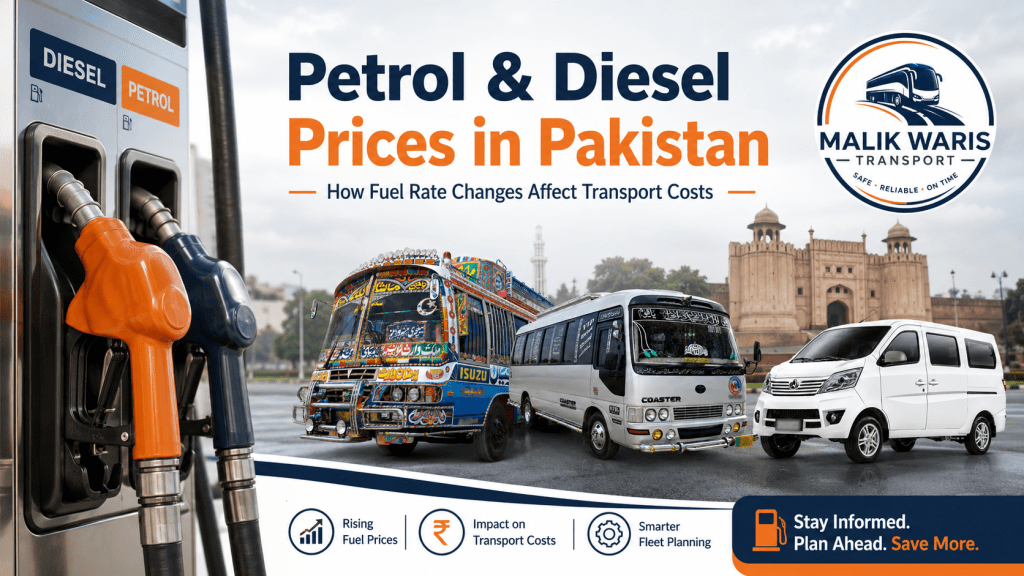
Petrol and diesel prices directly affect transportation costs across Pakistan. Whenever fuel rates increase or decrease, businesses operating staff vans, coasters, buses and commercial fleets may need to review their monthly transport expenses.
For companies using daily employee pick and drop or monthly staff transport services, fuel is one of the most important operating costs. Understanding fuel-price changes helps companies prepare accurate budgets and agree on transparent transport contracts.
Latest Petrol and Diesel Prices in Pakistan
According to Pakistan State Oil’s published rates effective from 5 August 2026, Premier Euro 5 petrol is listed at Rs.328.56 per litre, while Hi-Cetane Diesel Euro 5 is listed at Rs.385.86 per litre. PSO notes that final retail prices may include applicable freight charges depending on the outlet location.
Because fuel prices can change frequently, visitors should check our regularly updated Fuel Rates Pakistan page for the latest petrol and diesel prices.
Why Fuel Prices Affect Transport Costs
Transport companies have several regular operating expenses, including vehicle maintenance, driver salaries, tyres, route permits and insurance. However, fuel consumption is one of the largest variable costs.
When petrol or diesel prices rise, the cost of operating a van, coaster or bus also increases. The exact effect depends on:
- Daily route distance
- Number of shifts
- Vehicle fuel average
- Traffic and road conditions
- Number of working days
- Additional or overtime trips
A vehicle completing several long-distance factory routes every day will be affected more than a van operating on a shorter office route.
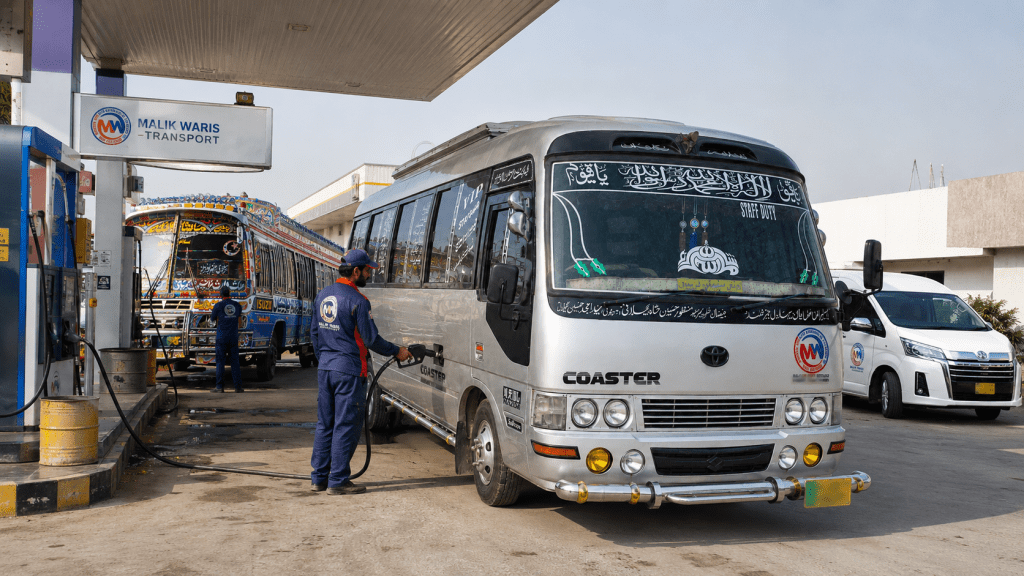
Pakistan’s Economic Survey also explains that higher petrol and diesel prices increase transportation and industrial production costs and can contribute to wider inflationary pressure.
Impact on Staff Transport Services
Factories and offices usually arrange transportation through fixed monthly contracts. These contracts may include the vehicle, driver, maintenance and an agreed quantity of fuel.
When fuel rates change significantly, the original transport cost may no longer reflect the actual operating expense. This can create problems when fuel-adjustment terms are not clearly included in the agreement.
Companies should therefore discuss:
- The base petrol or diesel price
- Estimated daily fuel consumption
- Monthly route kilometres
- Method of calculating fuel adjustments
- Treatment of fuel-price reductions
- Charges for additional routes or shifts
A transparent calculation protects both the company and the transport provider.
Should Monthly Transport Rates Change with Fuel Prices?
This depends on the agreed contract.
Some transport contracts use a fixed monthly rate for a specific period. Others separate the vehicle rent from the fuel provided by the client. A third option is to include a fuel-price adjustment clause.
For example, the agreement can mention that monthly charges will only be reviewed when the official fuel price increases or decreases beyond an agreed limit.
The calculation method should be written clearly instead of using a general statement such as “charges may change according to fuel prices.”
How Companies Can Control Transport Costs
Companies can reduce unnecessary fuel expenses through better route and vehicle planning.
Employees living near each other should be placed on the same route. Unnecessary stops and opposite-direction diversions should be avoided where possible.
The vehicle should also match the number of passengers:
- A van is suitable for smaller groups.
- A coaster is practical for medium-sized routes.
- A bus is more suitable for a large workforce travelling from common areas.
Using several small vehicles for employees travelling on the same route can sometimes cost more than operating one suitable coaster or bus.
Why Check Fuel Prices Regularly?
Regular fuel-rate monitoring helps companies:
- Prepare accurate transport budgets
- Check monthly fuel bills
- Compare transport quotations
- Calculate route expenses
- Review fuel-adjustment claims
- Plan future staff transport contracts
Official fuel notifications and company-published rates should be used instead of relying only on social media posts. OGRA maintains a notified petroleum-prices section, while PSO provides current and historical fuel-rate records.
Malik Waris Transport Services
Malik Waris Transport provides staff transportation, factory employee pick and drop, corporate transport and monthly transport contracts across Lahore and Punjab.
Available fleet options include:
- Vans and Grand Cabins
- Toyota Coasters
- Isuzu buses
- Hino and Euro buses
Routes and quotations can be prepared according to passenger numbers, daily distance, shift timings and current fuel requirements.
For updated petrol and diesel rates, visit our Fuel Rates Pakistan page.
Safe • Reliable • On-Time