Reliable transportation is an important operational requirement for companies with employees travelling daily between residential areas, offices, factories, warehouses and industrial estates. A delayed vehicle, unsuitable route or poorly managed driver can affect employee attendance, shift handovers and overall business productivity.
Professional corporate transport services in Lahore help companies organise employee movement through fixed routes, suitable vehicles, experienced drivers and planned pickup and drop-off timings. However, businesses should not select a transport provider only because it offers the lowest monthly quotation.
Before hiring a corporate transport company, management should evaluate its experience, fleet condition, legal documentation, route-planning process, driver standards, backup arrangements and contract terms.
Malik Waris Transport provides staff transport, corporate transport, daily pick and drop, bus rental and monthly transport contract services for companies, factories, schools and industrial organisations across Lahore and Punjab. The company states that it has more than 30 years of transport experience and operates vehicles for regular business movement.
This guide explains the most important points companies should check before choosing a corporate transport provider in Lahore.
What Are Corporate Transport Services?
Corporate transport services are planned transportation arrangements provided to companies for the regular movement of employees, management teams, factory staff, visitors or business groups.
Unlike occasional vehicle rental, corporate transportation normally operates according to agreed routes, shift timings, passenger numbers and monthly terms.
A corporate transport arrangement may include:
- Daily employee pick and drop
- Office staff transportation
- Factory and industrial staff transport
- Morning, evening and night-shift routes
- Executive and management transportation
- Dedicated vans, coasters or buses
- Monthly transport contracts
- Corporate event transportation
- Airport pickup and drop
- Route planning and operational coordination
The exact service depends on the company’s workforce size, location, working schedule and transport budget.
Why Selecting the Right Transport Provider Matters
Employee transportation affects more than daily travel. It can influence staff punctuality, employee satisfaction, administrative workload and shift productivity.
A reliable transport provider helps employees reach the workplace at the required time. It also gives administration and human resource teams a central contact for route changes, driver coordination, vehicle issues and billing.
An unsuitable provider may create repeated delays, complaints, unexpected charges or vehicle shortages. Companies should therefore complete proper checks before signing a long-term agreement.
1. Check the Provider’s Corporate Transport Experience
The first consideration should be the provider’s experience in handling regular company routes.
Corporate transport is different from wedding transport, tour services or occasional bus rental. It requires daily coordination, fixed schedules, driver discipline and an understanding of company reporting times.
Ask the provider whether it has experience with:
- Office staff pick and drop
- Factory employee transportation
- Multiple employee routes
- Shift-based transportation
- Industrial-area routes
- Monthly corporate contracts
- Large passenger groups
- Early-morning or late-night operations
An experienced provider should be able to understand passenger numbers, route distance, workplace timing and the most suitable vehicle without creating an unrealistic schedule.
Malik Waris Transport describes its main services as staff transport, corporate transport and bus rental for offices, factories, schools and business groups across Punjab.
2. Inspect the Available Fleet
Companies should inspect the vehicles that will actually be used on their routes. A provider may show pictures of modern vehicles but assign a different vehicle after the contract begins.
Request current photographs or conduct a physical inspection before final approval.
Important fleet checks include:
- Vehicle model and condition
- Passenger seating capacity
- Air-conditioning availability
- Tyre condition
- Cleanliness
- Interior seating
- Doors and emergency exits
- Lights and indicators
- Spare wheel
- Basic tool kit
- Fire extinguisher
- First-aid kit
The vehicle should be suitable for the number of employees and the road conditions on the selected route.
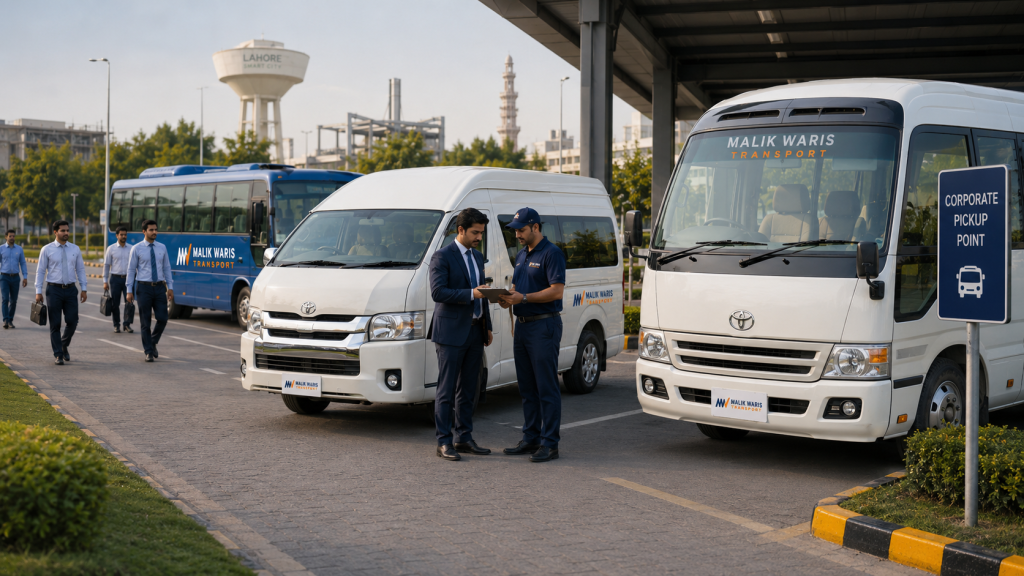
A small team may need a van or Grand Cabin, while a medium-sized employee group may require a coaster. Larger factory or industrial routes may need an Isuzu or Hino bus.
3. Select the Right Vehicle Capacity
Choosing the correct vehicle is important for both comfort and cost control.
Hiring a large bus for a small number of employees can unnecessarily increase monthly expenses. On the other hand, using a small vehicle for too many passengers can create discomfort and safety concerns.
Companies should provide an accurate passenger count for every route. They should also consider expected changes in workforce size during the contract period.
Vans and Grand Cabins
Vans and Grand Cabins are suitable for:
- Small office teams
- Executive transportation
- Management staff
- Female employee routes
- Short-distance routes
- Airport transfers
- Department-specific transport
Coasters
Coasters are commonly used for:
- Office staff transportation
- Medium-sized employee groups
- Factory staff pick and drop
- School and college routes
- Corporate events
- Intercity employee movement
Buses
Buses are more suitable for:
- Large factory workforces
- Labour transportation
- Multiple-shift operations
- Industrial facilities
- Warehouses
- Large corporate groups
- Long-distance routes
A professional provider should recommend the vehicle according to passenger capacity rather than simply offering its most expensive option.
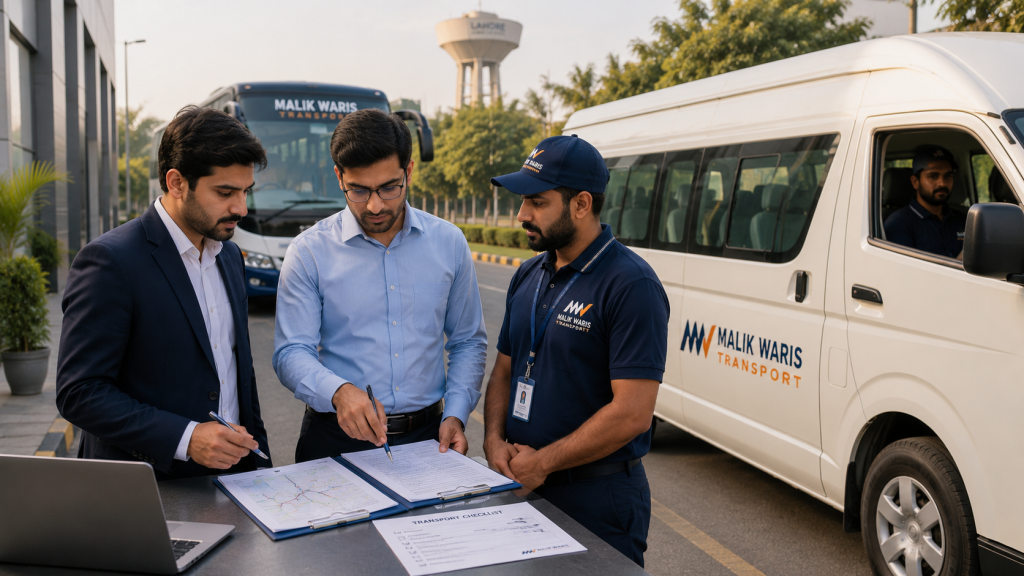
4. Verify Route Permits and Vehicle Fitness Documents
Legal and operational documentation is one of the most important areas to check.
Punjab’s Transport Department states that a transport vehicle should not be used without the relevant route permit. The department also states that public service and commercial transport vehicles operating in Punjab must obtain a Vehicle Fitness Certificate.
Depending on the vehicle and service arrangement, companies may need to review:
- Vehicle registration documents
- Route permit
- Staff-duty permit where applicable
- Vehicle fitness certificate
- Token tax status
- Driver’s licence
- Insurance documents
- Third-party risk coverage
- National identity card of the driver
Punjab Transport Company also lists specific documentation for staff-duty route permits, including a request letter from the institution receiving the transport service.
The exact documentation may depend on vehicle category, route and operating arrangement, so companies should verify current requirements with the relevant transport authority.
5. Evaluate Driver Experience and Conduct
The driver represents both the transport provider and, indirectly, the company using the service.
Drivers should understand that corporate transport requires punctuality, safe driving and respectful communication with employees.
Companies should ask about:
- Valid driving licence
- Experience with passenger vehicles
- Knowledge of Lahore routes
- Experience on industrial routes
- Traffic-rule compliance
- Behaviour with passengers
- Mobile-phone use while driving
- Attendance and punctuality
- Emergency response
- Replacement-driver arrangements
For large vehicles, the provider should assign a driver with appropriate heavy-vehicle experience and the required licence category.
The company may also request driver identity and licence details before the service begins.
6. Review the Route-Planning Process
A reliable corporate transport provider should not prepare a route based only on a list of employee addresses.
Proper route planning should consider:
- Employee residential areas
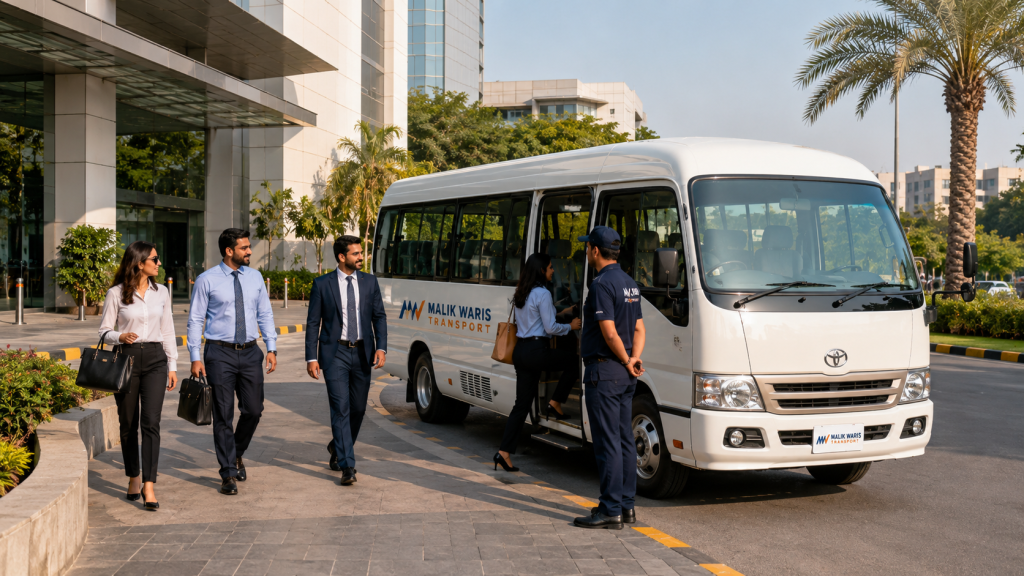
- Safe pickup points
- Workplace reporting time
- Traffic conditions
- Road accessibility
- Distance between stops
- Vehicle capacity
- Number of passengers
- Shift timings
- Expected boarding time
Employees living near each other should be grouped into the same route. Where door-to-door pickup is impractical, common pickup points can reduce travel time and improve punctuality.
For longer or complex routes, companies should request a physical route survey before approving the quotation.
7. Check Punctuality and Reporting Procedures
Corporate transport should operate according to agreed reporting and departure times.
Ask the provider how it manages:
- Daily vehicle departure
- Driver attendance
- Route delays
- Employee boarding delays
- Traffic diversions
- Vehicle breakdowns
- Factory arrival confirmation
- End-of-shift departure
- Communication with company administration
There should be one clearly identified coordinator from both the transport provider and the client company.
For large operations, a WhatsApp group or another agreed communication channel can be used for route updates. Messages may confirm when vehicles start their routes, reach the factory or leave after the shift.
Clear reporting reduces confusion and allows management to respond quickly when a route issue occurs.
8. Ask About Backup Vehicles
Vehicle breakdowns can happen even when a fleet is maintained properly. The important question is how the provider responds.
Before signing the agreement, ask:
- Is a backup vehicle available?
- How quickly can it be arranged?
- Will the replacement have similar capacity?
- Who will inform the company?
- Will replacement charges be additional?
- What happens if the vehicle remains unavailable?
The replacement procedure should be written in the quotation or agreement.
Companies with critical shifts should avoid depending on providers that have only one vehicle and no practical backup arrangement.
9. Review Maintenance and Safety Procedures
A vehicle used every day requires regular maintenance. Delayed maintenance can lead to breakdowns, safety concerns and route interruptions.
Ask the provider how it manages:
- Engine maintenance
- Brake inspections
- Tyre replacement
- Oil changes
- Electrical systems
- Air-conditioning
- Vehicle cleanliness
- Preventive maintenance
- Fitness inspections
- Repair records
Punjab’s Vehicle Inspection and Certification System is intended to improve passenger safety and control emissions by checking the fitness of public service and commercial vehicles.
Companies should also conduct their own visual inspection before accepting a vehicle for staff duty.
10. Compare Pricing Carefully
The lowest quotation is not always the most economical option.
A very low monthly rate may exclude fuel adjustments, overtime, additional kilometres, Sunday duty, public holidays or backup vehicles.
When comparing quotations, check whether the price includes:
- Vehicle
- Driver
- Fuel
- Maintenance
- Route distance
- Number of working days
- Daily duty hours
- Overtime
- Motorway or toll charges
- Driver accommodation where required
- Additional trips
- Night-shift charges
- Replacement vehicle
- Taxes
- Fuel-price adjustments
All quotations should be compared on the same route, vehicle category and service conditions.
A provider offering a slightly higher price may deliver better value if it includes a suitable vehicle, experienced driver, documented compliance and reliable operational support.
11. Understand Fuel-Price Adjustment Terms
Fuel prices can directly affect the monthly cost of corporate transportation.
The agreement should explain whether the monthly rate is fixed for the full contract period or whether it can be revised when petrol or diesel prices change.
A fuel-adjustment clause should clearly describe:
- Base fuel price
- Date of the base rate
- Type of fuel used
- Adjustment calculation
- Minimum change required
- Effective date of revised charges
- Process if fuel prices decrease
Companies should avoid vague terms such as “price may change according to fuel” without an agreed calculation method.
A transparent fuel-adjustment formula protects both the client and the transport provider.
12. Confirm Service Areas and Route Feasibility
A provider may offer transport services in Lahore but lack experience on routes outside central areas.
Companies should confirm whether the provider can serve locations such as:
- Sundar Industrial Estate
- Raiwind
- Manga Mandi
- Multan Road
- Ferozepur Road
- Kasur
- Sheikhupura
- Okara
- Renala Khurd
- Other areas across Punjab
Outer-city and industrial routes may require different departure times, vehicle types and maintenance planning.
Malik Waris Transport states that it provides staff and corporate transport services across Lahore, Sundar Industrial Estate, Raiwind, Kasur, Sheikhupura, Okara, Renala and other areas of Punjab.
13. Review Communication and Complaint Handling
A transport provider should have a clear process for resolving complaints.
Companies should know whom to contact regarding:
- Driver behaviour
- Vehicle cleanliness
- Late arrival
- Route changes
- Employee complaints
- Unsafe driving
- Breakdown
- Substitute vehicles
- Billing errors
- Additional trip requests
A complaint should not depend only on contacting the driver. There should be a manager, owner or transport coordinator responsible for resolving operational issues.
The agreement may also include an escalation process for repeated delays or safety concerns.
14. Check Flexibility for Shift Changes
Companies frequently change employee numbers, reporting times or production shifts.
Before hiring a provider, ask whether it can manage:
- Temporary shift changes
- Overtime duty
- Weekend operations
- Additional routes
- Employee relocation
- New pickup points
- Route extensions
- Seasonal workforce increases
- Temporary vehicle upgrades
Any additional charges should be agreed before the change is implemented.
A flexible provider can help the company adjust transport operations without replacing the entire contract.
15. Request References or Existing Client Experience
Companies may ask the provider about previous or current experience with factories, offices and industrial clients.
Useful questions include:
- How long have you managed corporate routes?
- What types of companies have you served?
- Have you handled multiple vehicles at one site?
- Can you manage different shifts?
- Do you have experience with industrial estates?
- How do you handle daily route reporting?
- Can you provide a client reference where appropriate?
Client experience should be verified carefully. A provider should not use company logos or names without authorisation.
16. Read the Monthly Transport Contract Carefully
The agreement should clearly define the responsibilities of both parties.
Important contract sections include:
- Route and pickup points
- Workplace destination
- Vehicle type
- Passenger capacity
- Reporting time
- Shift schedule
- Monthly charges
- Payment due date
- Contract duration
- Fuel-adjustment terms
- Overtime charges
- Additional kilometre charges
- Driver responsibilities
- Client responsibilities
- Maintenance
- Backup vehicle
- Accident reporting
- Insurance
- Taxes
- Notice period
- Termination conditions
Verbal promises should be added to the written agreement before signing.
Corporate Transport Hiring Checklist
Before approving a corporate transport provider, confirm the following:
- The provider has relevant company transport experience.
- The proposed vehicle has been physically inspected.
- Vehicle capacity matches the employee count.
- Registration and permit documents are available.
- The vehicle has a valid fitness certificate.
- The driver has a valid and suitable licence.
- Routes and pickup points have been surveyed.
- Reporting and departure times are written.
- Backup vehicle arrangements are clear.
- Maintenance responsibilities are defined.
- Fuel-price adjustments are transparent.
- Overtime and additional charges are stated.
- Complaint contacts are available.
- Payment terms are agreed.
- Notice and termination clauses are understood.
Common Mistakes Companies Should Avoid
Selecting Only on Price
A cheap quotation may lead to an unsuitable vehicle, repeated breakdowns or unexpected additional charges.
Not Inspecting the Vehicle
Companies should inspect the exact vehicle before service begins rather than relying only on photographs.
Ignoring Backup Arrangements
A route can stop completely if the provider has no replacement vehicle.
Accepting an Unclear Fuel Clause
Fuel adjustments should be based on a written formula rather than an informal demand.
Not Defining Pickup Points
Unclear pickup arrangements can create daily delays and employee complaints.
Signing Without Checking Documents
Vehicle registration, permits, fitness and driver documents should be reviewed before operations begin.
Depending Only on the Driver
The provider should assign a management contact for complaints, route changes and emergency coordination.
Why Choose Malik Waris Transport?
Malik Waris Transport provides corporate transport solutions for companies, offices, factories, schools and industrial organisations across Lahore and Punjab.
The company offers:
- Corporate transport services
- Staff transport service
- Employee pick and drop
- Factory staff transportation
- Labour transportation
- Bus rental services
- Coaster rental
- Van and Grand Cabin rental
- Monthly transport contracts
- Route-based transport planning
Its available transport options include vans, Grand Cabins, coasters, Isuzu buses and Hino buses for different passenger and route requirements.
Malik Waris Transport states that its service focuses on safe routes, punctual arrivals, experienced drivers, maintained vehicles and support for long-term business transport requirements.
Information Required for a Corporate Transport Quotation
Companies should provide the following details to receive an accurate quotation:
- Company or factory location
- Employee pickup areas
- Exact pickup points, where available
- Total passenger count
- Number of routes
- Reporting and departure times
- Number of shifts
- Required vehicle type
- Working days per month
- Expected start date
- Contract duration
- Overtime requirements
- Weekend or holiday operations
- Any special safety or reporting requirements
A route survey may be needed before the final monthly price is confirmed.
Request Corporate Transport Services in Lahore
Choosing a corporate transport provider is an operational decision that should be based on safety, reliability, vehicle condition, legal compliance and service management—not price alone.
Companies should compare providers carefully, inspect the proposed fleet, verify relevant documents and ensure that all routes, charges and responsibilities are included in the written agreement.
Malik Waris Transport provides customised corporate transport services in Lahore for offices, factories, industrial clients and organisations requiring daily employee movement or long-term monthly transport contracts.
Share your routes, passenger count, shift timings and workplace location to receive a suitable vehicle and transport plan.
Contact Malik Waris Transport for a corporate transport quotation.
Safe • Reliable • On-Time